Five Missions In: What This Work Is For
The network held, the system rebuilt, and 1,121 patients were served. On the last day of the 10th anniversary mission, a certificate. On what Grano de Oro actually is, and why the infrastructure matters.
MMDM's 10th Anniversary Mission
The Costa Rica 2026 mission ran April 18–25 in Grano de Oro, a Cabécar indigenous community in the mountains of Costa Rica. Thirty-nine missionaries and 13 local Cabécar-Spanish translators, several of whom have served alongside MMDM for seven or eight years, served a record 1,121 patients in a single week. That included 151 patients seen during a one-day outreach to Bloriñak. It was MMDM's 10th anniversary mission.
What Grano de Oro Actually Is
You do not so much arrive at Grano de Oro as earn it.
From the airport it is more than six hours by bus, the whole way, no transfers, no shortcuts. In the good years there is time to stop at the basilica and eat from a street cart; in the lean ones you hold out for the rest stop at the foot of the mountain and find out what your patience is actually worth. Either way the road only runs one direction, which is up. The bus climbs past small towns, past coffee farms laid out across the slopes, past cattle standing in fields that fall away into nothing, and with every switchback the country thins out and civilization recedes behind you.
Then the day gives out. Somewhere in the climb the light goes and you are left trusting a driver you have known for an hour to thread a bus along a dirt road with no guardrail and a drop a few inches off the tire. You hear the mountain before you feel it: small rocks flicking up against the underside of the bus, the concrete long since surrendered to dirt. The veterans read the road by sound. The last well-built bridge means you are on the right track. When the potholes turn cavernous and the pebbles become stones that hammer the chassis like a mechanic gone to work beneath your feet, you are less than forty minutes out. I still remember my first trip: the dips and the lurching, the whole bus pitching like a rock crawler, all of us holding on in the dark. And then, finally, lights. We've arrived.
What you cannot see in the dark, you see on the way up by day, and it does not look real. It looks animated, the kind of background that scrolls on forever in a film, mountains caving into valleys and then simply continuing, each ridge behind the last somehow larger than the one before it, until the farthest of them towers over everything and your eye gives out before the land does. There is an active volcano within sight. You watch the smoke rise off a distant peak and your first thought is that a city is burning, until you understand that nothing could live that high, alone, up there.
The clinic itself sits beside a school. The school's main room holds Registration, Triage, and Dental. The church is only a few steps behind it, though you have to come around to the front to get in, since barbed wire fences the main building's perimeter. Behind the church is Vision, a single large barn that has been given tile floors, proper walls, and windows. Behind that, a row of small classrooms becomes the medical clinic. It is all indoors and none of it is cool; there is no air conditioning, so we bring our own plug-in fans, leave every door open, and let the mountain air do what it will. The flow through it is something we have earned over years of setups that didn't work. A patient begins outside, registers, sits for triage (the longest wait of the day), and is sent on to whichever clinic they need. Medical sees families one at a time, in an enclosed room, with the privacy the other stations can't always offer.
The patients range from infants to people in their nineties, sometimes older. Everything we do is free; the only thing a patient might be asked to help cover is a medication we don't have on hand, and even then we try to find a way to carry the first fill ourselves. Outside, horses stand tied to trees in full sun for the length of a day while the people who rode them inch through the line. Some walked twenty miles to be here. They arrive at six in the morning and sit until we open at eight, and they wait, many of them eight hours, only to be told that Dental is full today and to please come back tomorrow. And they smile.
That is the part that stays with me. They remember us. They come back every year and they know our faces, and we look back at them with nothing, because we see too many people in too few days and a year is a long time to hold a stranger in your head. I have overheard more of their stories than I have ever stopped to ask about, and I mean to fix that, to spend a future mission listening, walking the line in a patient's shoes, before I decide how their information should become digital. Because the most basic thing a record could do is let a patient have a history. Not a diagnosis, not a cure, just a history. Something that lets us keep track, form an opinion about who is urgent, and finally use the handful of tools that a roomful of doctors and volunteers from a wealthy country have so far failed to bring to bear up here. That, at the very least, is what I came to build.
Five Missions
This was my fifth MMDM mission. My first was to Laredo in 2018. This one was different: for the first time, technology was my primary role rather than clinical support.
The four missions before this one I spent on the Vision team: back to Costa Rica in 2023, Laredo again in 2025, and two others whose years have blurred together the way mission years do. On Vision I started at the tonometer, an older unit that still worked by magnet, a small probe that pressed against the eye. I had a steady hand; I could pull all six readings faster than anyone else on the team, and for a while that was my whole identity on the line. Then I learned the rest of the room: the Snellen chart, the old glaucoma machine where the patient clicks each time a circle appears, the autorefractor, and the readers, where I'd work through a translator to find someone the right pair and watch their face change when the print came into focus.
This year was different. For the first time, the technology was my job, not something I did between patients. I spent the early days running between the clinic and the compound, a fast five-minute walk each way if I pushed it, to make changes to the EMR and field questions about the forms. Later I found I could reach Starlink from the priest's house, which is the kind of thing that sounds small and isn't: it is the seed of how we might one day efax a prescription straight out of these mountains. On the second-to-last day I stopped fixing things long enough to watch. I went station to station and studied the whole machine of it: how the flow actually moved, what got said aloud but never written down, how long a patient really took, how often some odd case turned up that nobody had planned for. I built a list.
That is the thing a station can never show you. For four missions I saw Vision, and only Vision. This year I saw the whole organism, and the things that only reveal themselves from above. The clearest of them: no matter what, you need a runner. We can hand every patient a printed map and post signs at every turn, and they will still get lost without a person to walk them. It costs time we don't have, and it is not optional. You cannot design it away. You design around it.
And everything breaks. If it rained, something would die the next day of the humidity. A bug in the patient records was the worst of it that week. The Ethernet runs weren't long enough; the wires we wanted strung through the air between buildings kept ending up on the ground. So you adapt, because the resources are what they are. We re-routed the cable, worked with the priest for access to the shed off the church, and ran the lines through the windows. We moved the access points around and tested signal in one spot after another. None of it was finished. It was a first pass, a learning stage, the whole point of which was to make sure the next mission walks in with everything it needs. More will break next time. The work is adapting to it.
The Certificate
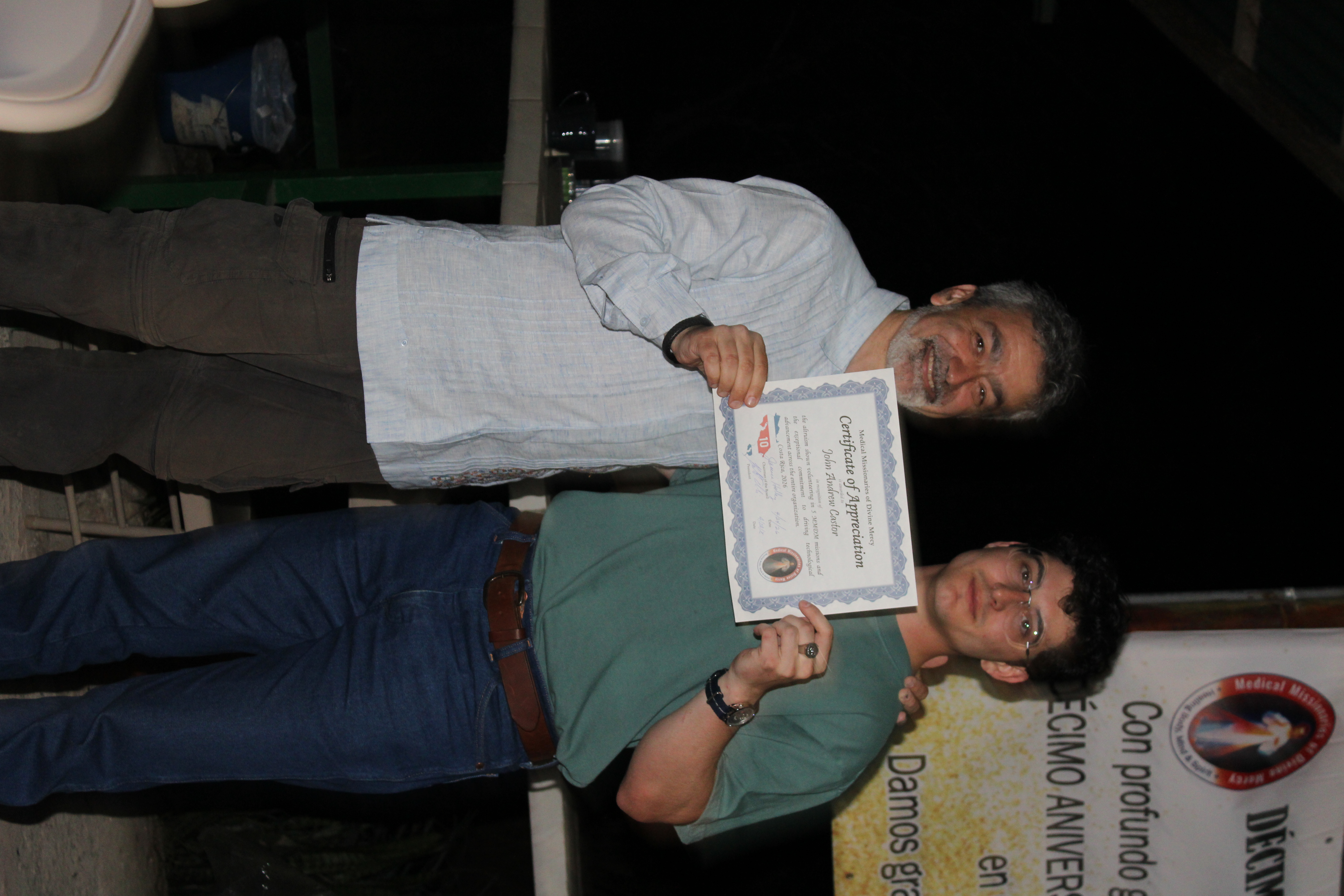
On the last evening of the mission, Roberto Orlandi presented a Certificate of Appreciation: for five missions, and specifically for the work of driving technological advancement across the organization.
It came at the end of dinner. The certificates are new. Roberto, as President, has been building out ways to mark what people give: magnetic logo pins for five years, ten years, the milestones, the kind you collect over time. First-year volunteers get a certificate too, and then again at every five years or a major mark; one man was honored this year for his thirtieth mission. Nearly half the room was new, so the certificates went out to a crowd of first-timers and veterans together, under the lights, at the end of a long week.
I don't much like being given things for showing up. The job isn't done, and I don't think a person should be praised for what he hasn't finished yet. I held a proud smile for the photograph, because it is still a gift and I will accept a gift graciously. But what I was actually thinking, standing there, was how much further I have to go before I've earned it. I want to be a link this team can't do without. I intend to finish what I started, for the people of Costa Rica, of Laredo, of the Philippines, and for the missions still ahead, here and abroad.
What the Infrastructure Is For
The system we built is not the point. Not the server, the forms, the network, the private CA, or the offline-first architecture. It is all infrastructure. The point is that a patient seen this year can be known the next.
What matters is what it makes possible: that the woman who walked twenty miles, waited eight hours, and smiled at us anyway might one day soon be a face we actually remember, because the record remembered for us. That is what I came up the mountain to build. It isn't built yet. That's the part I keep.